
Need Help? Email Me HERE
For The First Time, A Disaster Preparedness Expert Reveals:
That Uneasy Feeling You Get When The Lights Flicker? Here's How To Make It Disappear Forever
The simple system that turns "What if something happens?" into "We're ready for whatever happens" without becoming a "prepper," spending thousands, or changing your lifestyle
I'm loving the amazon links for the bundles and the prices listed - this is the best and most useful emergency prep materials I have purchased by far!!! So practical. Thank you!
- Erika J.
You know that feeling...
The storm warning comes across your phone.
The power flickers for a second.
The news mentions supply chain issues.
And somewhere in the back of your mind, a quiet voice asks:
"What would we actually do if...?"
You push it away. Life is busy. The lights come back on. The storm passes.
But the feeling doesn't fully go away, does it?
It's not panic. It's not paranoia.
It's uncertainty.
And your brain hates uncertainty.
Neuroscientists have proven that humans are hardwired to seek control over their environment.
When we don't have it—when we can't answer "What would we do if?"—our stress response stays activated in the background.
It's exhausting. Even when nothing bad is happening.
Here's what most people do with that feeling:
They ignore it (and the background anxiety stays).
They buy a flashlight and some batteries (and still don't feel ready).
They look into "prepping" (and get overwhelmed by bunkers, bug-out bags, and doomsday scenarios that feel extreme).
None of these actually solve the problem.
Because the problem isn't that you lack stuff.
The problem is that you lack a SYSTEM—a clear, simple answer to "What would we do?"
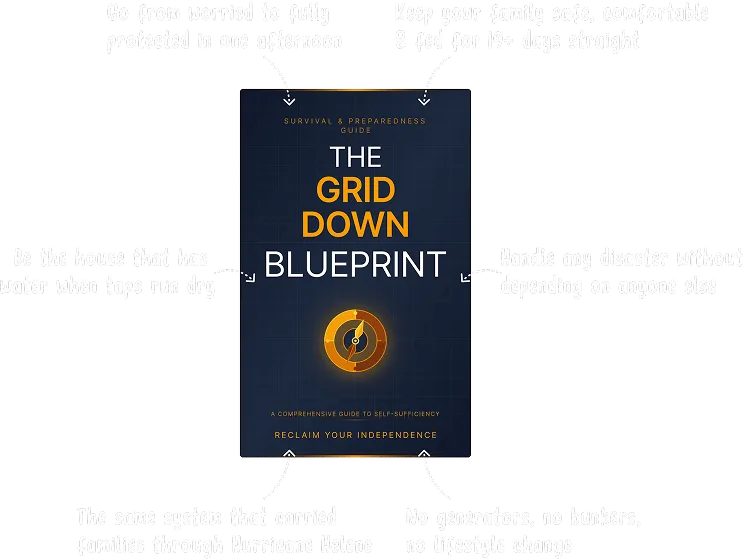
That's exactly what The Grid-Down Blueprint gives you.
Not fear-based survivalism.
Not expensive gear.
Not a lifestyle change.
Just a straightforward system that takes the question "What if?" and turns it into "Here's what we do."
And once you have that?
The background anxiety disappears.
The lights can flicker all they want.
You'll know exactly what happens next.
What Changes When You Actually Have a Plan:
Let me paint two pictures.
Picture #1: The Unprepared Family
A winter storm knocks out power. It's supposed to last "a few hours."
Then it becomes a day. Then two.
The house is getting cold. The kids are scared. Your phone is at 12%.
You're digging through drawers looking for candles. Wondering if the food in the fridge is still safe.
Trying to remember if you have bottled water anywhere.
Every decision feels urgent. You're reacting, not responding.
Your spouse asks, "What do we do?"
And you don't have a good answer.
This is what uncertainty feels like when it becomes real.
Picture #2: The Family With a System
Same storm. Same outage.
But this time, you walk to the closet where your supplies are organized.
You tell the kids: "Okay, we're going to do our camping setup in the living room."
You know exactly how much water you have (plenty).
You know which food to eat first and which will last.
You have light that doesn't need batteries, heat that doesn't need fuel, and a phone that will stay charged for a week.
Your spouse asks, "What do we do?"
And you say: "We're already doing it."
This is what control feels like.
Not control over the storm—you can't control that.
Control over your response.
The ability to respond with confidence instead of react with panic.
That's what The Grid-Down Blueprint creates:
Certainty — You know exactly what to do when the power goes out (no scrambling, no guessing)
Competence — You have real skills and systems, not just stuff in a drawer
Calm — Your family takes cues from you; when you're calm, they're calm
Confidence — The background anxiety disappears because you've answered the "what if?"
And here's what you DON'T have to do:
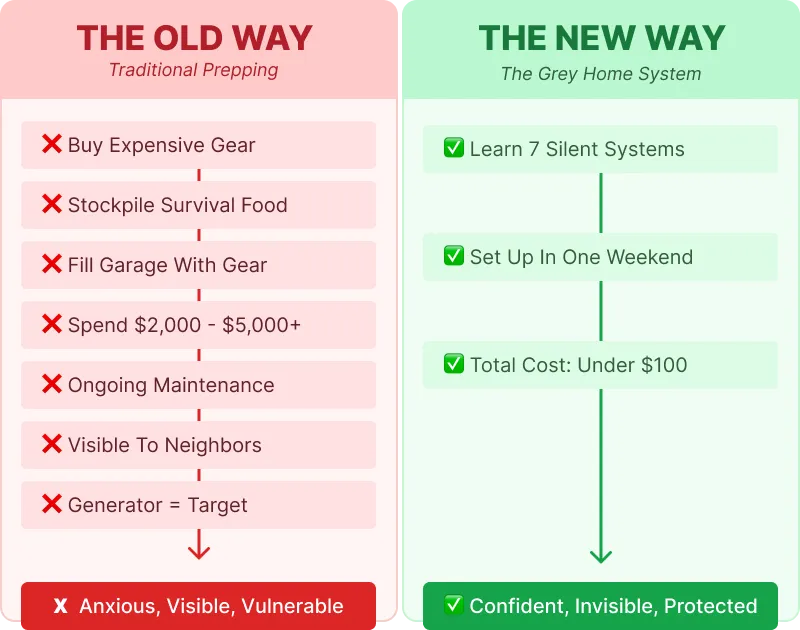
Spend thousands of dollars
Fill your garage with stockpiles
Become a "prepper" (whatever that even means)
Change your lifestyle
Scare your family with doomsday talk
The entire system costs under $100, fits in a closet, and looks completely normal to anyone who visits your home.
Your neighbors won't know. Your family won't think you've gone off the deep end.
You'll just be the household that handles disruptions without drama.
This Isn't About Doomsday. It's About Tuesday.
Let me be clear about something.
This isn't about preparing for the apocalypse.
It's about preparing for the disruptions that already happen - and that are happening more frequently.
Here's what "normal" looks like in America now:
The average American household experiences 8+ hours of power outages per year, double what it was a decade ago.
Major grid failures have increased 67% since 2000.
In 2024 alone:
- Hurricane Helene left communities without power for 19 days
- Winter storms knocked out power to millions across the South
- Heat waves strained grids in Texas, California, and Arizona
- Wildfires forced evacuations across multiple states
These aren't rare events. They're regular events.
Supply chain disruptions? They happen.
Remember 2020? Empty shelves. No toilet paper. Bottled water sold out.
That wasn't a one-time anomaly. It's what happens when systems get stressed.
During Hurricane Helene, stores ran out of water 200 miles from the disaster zone...
...because everyone within driving distance panicked at the same time.
Here's the reality:
You don't need to prepare for a nuclear war or societal collapse.
You need to prepare for:
A 3-day power outage in winter
A week without running water after a main break
Stores being empty when a storm approaches
Cell service going down when you need it most
These are the things that actually happen to actual families.
And when they happen, there are two types of households:
The ones scrambling — digging through drawers, driving to empty stores, rationing phone battery, feeling helpless
The ones executing their system — calm, organized, comfortable, handling it
The Grid-Down Blueprint puts you in the second category.
Not because you're paranoid.
Because you're practical.
What Actually Happened During Hurricane Helene
On September 26, 2024, Hurricane Helene made landfall as a Category 4 storm.
The numbers tell the story:
- 227 confirmed deaths — the deadliest mainland hurricane since Katrina
- 6+ million customers lost power
- 19 days without electricity in some areas
- Communities completely cut off — no roads, no cell service, no help
I spent weeks studying survivor accounts. Interviewing families. Analyzing what worked.
Here's what I found:
The families who suffered most weren't necessarily unprepared.
Many had generators. Stockpiles. Expensive gear.
But their preparations failed in ways they didn't expect:
- Generators ran out of fuel by day 4 (and made them targets once neighbors heard them running)
- Freeze-dried food required boiling water they couldn't produce
- Massive stockpiles attracted attention they didn't want
- Complicated systems broke down without power or maintenance
The families who thrived were different.
They weren't the most equipped. They were the most systematic.
They had:
Simple solutions that didn't require fuel
Food that didn't require cooking
Light and power that made no noise
Setups that were invisible to neighbors
One family in Black Mountain, NC told me:
"By day three, people were knocking on doors asking for water.
Some were getting aggressive.
We kept our blinds closed, didn't run any lights at night, and never mentioned we had supplies.
We never felt unsafe because nobody knew we had anything."
This is the Grey Home System in action.
Not the most gear.
The smartest system.
A Timeline of Why This Matters More Than Ever
1977 — New York City Blackout 25 hours. 1,600 stores looted. 1,000+ fires. The first modern proof of how fast society unravels.
2003 — Northeast Blackout 55 million people. $6 billion in damages. It was supposed to be "impossible."
2012 — Hurricane Sandy 8.5 million without power. Some for 2+ weeks. Gas lines stretched for miles.
2017 — Hurricane Maria Puerto Rico went 11 months without full power restoration. Nearly 3,000 dead.
2021 — Texas Winter Storm 4.5 million homes lost power. 246 deaths. Families froze in their own homes while the grid collapsed.
2024 — Hurricane Helene 19 days. 227 deaths. Communities still rebuilding.
The pattern is undeniable:
Outages are getting longer.
Recovery is getting slower.
The grid is getting more fragile, not less.
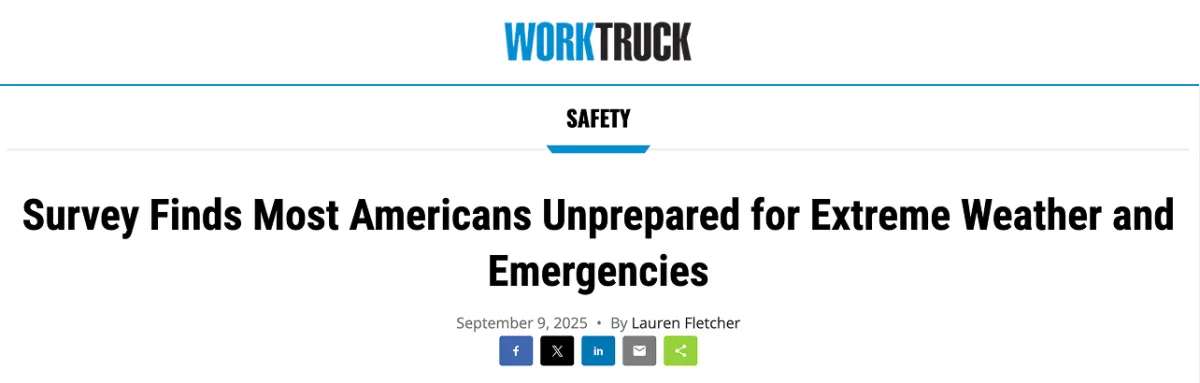
The American Society of Civil Engineers gives our power infrastructure a C- rating.
73% of transmission lines are over 25 years old.
And climate events are intensifying every year.
This isn't fear-mongering. It's pattern recognition.
The families who thrive during disruptions aren't lucky.
They're ready.
Why You Haven't Prepared Yet (And Why It's Not Your Fault)
If you're like most people, you've thought about this before.
Maybe after a storm. Maybe during the pandemic.
Maybe when you saw news coverage of a disaster.
You thought: "I should really have a plan."
But then... nothing happened.
Not because you don't care.
Not because you're lazy.
Because the preparedness industry made it overwhelming.
Here's what happens when most people try to get prepared:
Step 1: You search "emergency preparedness" or "how to prepare for power outages"
Step 2: You're immediately bombarded with:
$3,000 generators
Bug-out bags with 47 items
Bunker construction guides
Freeze-dried food pallets
"Tactical" gear that looks like military equipment
Doomsday scenarios about societal collapse
Step 3: You think: "This isn't me. I don't want to be a 'prepper.' This feels extreme."
Step 4: You close the browser and do nothing.
Sound familiar?
Here's what happened:
You got caught in the gap between "I should do something" and "I don't want to do THAT."
And that gap is intentional.
The preparedness industry is an $11 billion market. They profit by making you feel like you need more:
More gear
More supplies
More training
More money spent
But the families who handle emergencies well?
They don't have the most stuff.
They have the simplest systems.
They didn't spend thousands—they spent under $100.
They didn't become "preppers"—they just became organized.
They didn't change their lifestyle—they added one closet's worth of supplies and a plan.
The Grey Home System is designed for people who:
Don't want to be "preppers"
Don't have thousands to spend
Don't have a garage or basement for stockpiles
Don't want to scare their families
Don't have time for complicated maintenance
You just want a simple answer to "What would we do if...?"
That's exactly what this provides.
What Families Are Saying:
"Thought I was prepared until I read this. Counted 11 things I was dead wrong about—things that could've gotten my family hurt in a real emergency. The images make everything clear. I took photos of key pages and keep them on my phone now. This isn't theory—it's what you actually need."
— Josh S, North Carolina
"We're in a 900 sq ft apartment. I didn't think we had room to 'prep.' This showed me we had everything we needed already—we just didn't know how to use it. Took me one afternoon to set up. I sleep better now."
— Amanda R, Dallas, TX
"No fluff. No fear-mongering. Just clear instructions that work in real life. My wife and I went through it together and now we actually have a plan instead of just worry."
— Marcus T, Phoenix, AZ
Why the "Experts" Have Failed You
The reason you don't feel prepared isn't a personal failing.
It's a system failure.
You've been given two options, and both are wrong:
Option A: "Just trust the system"
The government will help. FEMA will arrive. The power company will fix it.
But here's reality:
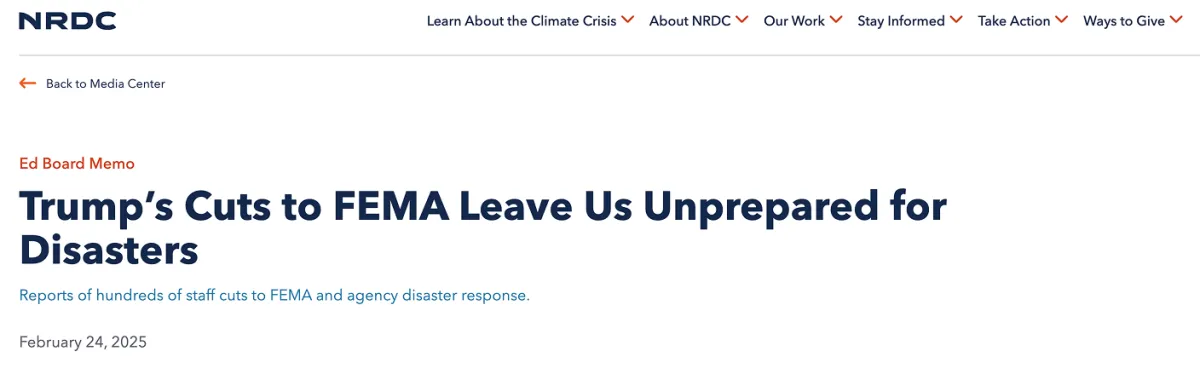
FEMA takes an average of 72 hours to establish a presence after major disasters
During Katrina, the response was so poor the director called it "a failure at all levels"
During the Texas Freeze, officials told people to "find shelter" while 4.5 million homes had no heat
During Helene, helicopters couldn't reach stranded families for days
The system isn't designed to save you in time.
It's designed to help with recovery after the worst is over.
For the first 72 hours (minimum), you are your family's only resource.
Option B: "Become a hardcore prepper"
This is what the industry sells you:
Bunkers and bug-out locations
Thousands in gear
Military-style equipment
Doomsday mindset
For 99% of people, this is overkill, unaffordable, and frankly uncomfortable.
Most people don't want to organize their life around worst-case scenarios.
They just want to handle disruptions without drama.
There should be a middle path.
Practical preparedness for normal people.
Systems that handle real emergencies without the extreme lifestyle.
Readiness that feels like common sense, not paranoia.
That middle path is what the preparedness industry doesn't want you to find.
Because practical people who feel confident don't keep buying more gear.
The Grey Home System is that middle path.
It's not about doomsday. It's about Tuesday.
It's not about surviving alone in the woods.
It's about handling a two-week power outage without stress.
It's not about fear. It's about competence.
And competence, once you have it, is the end of anxiety.
The Window for Easy Preparation Is Closing
Here's a truth about preparedness:
It's only easy to do BEFORE you need it.
Right now:
The stores are stocked
The roads are clear
Amazon delivers in two days
You have time to think, plan, and organize
When a disaster approaches:
Stores are chaos
Roads are gridlocked
Shipping stops
You're reacting, not planning
Every family that suffered during Helene had the same opportunity to prepare that you have right now.
They thought:
"It probably won't be that bad"
"I'll deal with it when it happens"
"Help will come"
They were wrong.
And the psychological reality is this:
Your brain is excellent at minimizing future risk.
We evolved to focus on immediate threats, not potential ones.
So your brain says: "The power is on right now. The stores are full. Everything is fine. This can wait."
This is called normalcy bias — the tendency to believe things will continue as they always have.
Normalcy bias is why people don't evacuate when warnings come.
It's why families don't stock water until the hurricane is in the Gulf.
It's why most people experience disasters unprepared, even when they had weeks of warning.
The families who thrive during emergencies are the ones who overcame normalcy bias.
They prepared during the calm so they could stay calm during the chaos.
Here's what's true right now:
Extreme weather events increased 83% in the last 40 years
Grid failures are at record levels
The next major outage isn't "if" — it's "when"
And when it comes, preparation will be impossible
The question isn't whether disruption will reach your area.
The question is whether you'll be ready when it does.
Preparing today takes an afternoon and under $100.
Preparing during a crisis takes a miracle.
From Anxious "Prepper" to Confident System Builder
I used to be exactly where you might be now.
That low-level anxiety. That nagging "what if?" That sense of vulnerability I couldn't shake.
So I did what most people do: I bought stuff.
A generator. Flashlights. Cases of water. Freeze-dried food.
My garage started filling up. My credit card got a workout.
And you know what?
I still didn't feel ready.
Because stuff isn't confidence. Stuff is just stuff.
I didn't have a SYSTEM. I had a collection.
When storms approached, I still felt anxious:
Would the generator work?
Did I have enough fuel?
What if the neighbors heard it running?
What was I forgetting?
The turning point came when I started studying what actually worked.
Not what preparedness "experts" sold.
What real families used during real disasters.
I read hundreds of survivor accounts from:
Hurricane Helene (2024)
The Texas Freeze (2021)
Hurricane Maria (2017)
California blackouts (2019-2023)
Hurricane Sandy (2012)
The pattern was unmistakable
The families with the most gear often struggled the most.
The families with simple SYSTEMS thrived.
The families who were visible became targets.
The families who were invisible stayed safe.
This led me to develop the Grey Home System.
Not another gear list.
A complete system that answers every "what if?" with a clear "here's what we do."
The result?
For the first time in years, I don't have background anxiety about emergencies.
Not because I'm certain nothing will happen.
Because I'm certain I know what to do if it does.
That's real psychological peace.
And that's what I want to give you.
Inside The Grid-Down Blueprint:
Seven Simple Systems
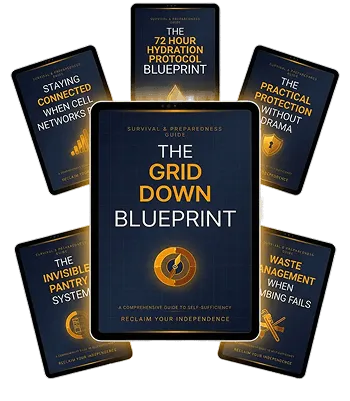
MODULE 1: WATER - The 72-Hour Hydration Protocol
The 72-Hour Hydration Protocol that shows you how to store, access, and purify water in any apartment even if your taps run dry.
MODULE 2: FOOD - The Invisible Pantry System
The Invisible Pantry System for feeding your family for weeks without refrigeration, cooking, or looking like a prepper.
MODULE 3: Power & Light - Silent Off-Grid Electricity
Silent, apartment-friendly electricity systems that keep phones charged and homes lit without generators or noise.
MODULE 4: Heating & Cooling - Staying Comfortable Without HVAC
Temperature control strategies that work when HVAC fails—stay warm in winter, cool in summer, all without fuel.
MODULE 5: Communication - When Cell Networks Fail
How to stay connected when cell networks collapse—the tools that worked during Helene while others went dark.
MODULE 6: Security & Safety - The Grey Home Principle
The Grey Home Principle—practical protection without paranoia, becoming the home that stays safe by staying invisible.
MODULE 7: Sanitation - When Plumbing Fails
Waste management when plumbing fails—maintain cleanliness, dignity, and health even in extended outages.
PLUS YOU GET 5 CRITICAL BONUSES:
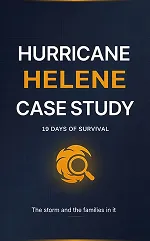
BONUS #1: The Hurricane Helene Case Study
A day-by-day breakdown of what really happened during the 19-day blackout, why families struggled, and what the most prepared households did differently. ($37 value)
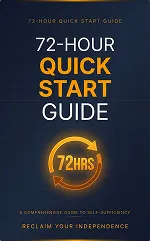
BONUS #2: The 72-Hour Quick Start Checklist
The fastest way to become 80% prepared tonight—even if you have zero prior preparation. ($27 value)
BONUS #3: The Grid-Down Shopping List
Exact items, quantities, and why they matter—all for under $200. No guessing, no wasted money.
($27 value)
BONUS #4: The Apartment Dweller's Adaptation Guide
How to implement every module in a small space with no yard, no storage, and no room for error.
($37 value)
BONUS #5: The Invisible Stockpile Strategy
How to store 2-4 weeks of supplies that look completely normal to visitors, landlords, and neighbors.
($37 value)
From Worry to Confidence
Before the Blueprint:
Background anxiety about "what if?"
No clear plan, just scattered supplies
Feeling vulnerable during storm warnings
Hoping nothing bad happens
After the Blueprint:
Every major "what if?" has a clear answer
A complete system in one closet
Confidence when warnings come
Knowing exactly what to do
This is what psychologists call "self-efficacy":
The belief that you can handle challenges that come your way.
It's the opposite of anxiety.
And it's what the Grid-Down Blueprint builds.
Here's A Taste Of What You'll Discover Inside The Grid-Down Blueprint:
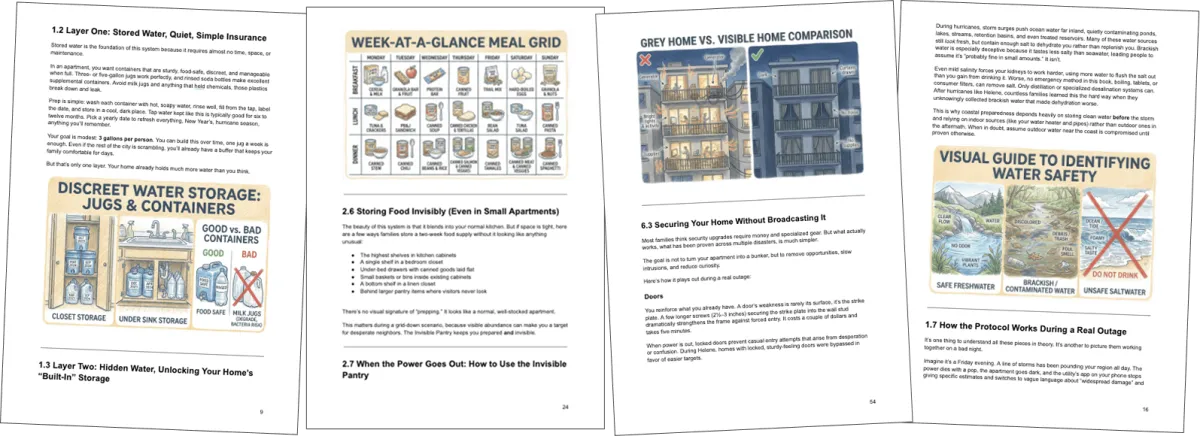
The "Grey Home Principle" that kept families safe during Hurricane Helene's 19-day blackout—while preppers with $3,000 generators became targets (this counterintuitive approach flips everything you've heard about emergency preparedness) — Module 6
Why the families who survived Helene BEST weren't "preppers" at all... and the invisible system they used that you can copy this weekend for under $100
The 40+ gallons of emergency water already hidden inside your home that 99% of people don't know about—even apartment dwellers have this — Module 1
3 reasons generators are actually a LIABILITY during extended outages (and the silent alternative that kept families powered for 2+ weeks during Helene without drawing attention) — Module 3
The $3 door reinforcement that stops 90% of break-in attempts (security experts charge hundreds to tell you this) — Module 6
What a Black Mountain, NC family did on Day 3 of Helene when desperate neighbors started knocking on doors—and why they never felt unsafe — Case Study
The "Invisible Pantry" method that builds a 2-week food supply from regular grocery store items your kids will actually eat—without anyone knowing you're "stocking up" — Module 2
Why your iPhone can text via SATELLITE and most people have no idea this feature exists (plus the $30 backup that works when every cell tower is down) — Module 5
The "One Room" strategy that makes temperature control actually achievable without generators or fuel — Module 4
The toilet solution that costs under $10 and maintains complete dignity—used by field medics when plumbing fails — Module 7
How to store 14 days of supplies in 4 square feet—perfect for apartments, condos, and homes without basements — Apartment Adaptation Guide
The phone discipline trick that extends battery life 5x during extended outages (most families drain their phones in 48 hours doing the opposite) — Module 3
Why FEMA takes 72 hours minimum to respond—and what you need to have in place before they arrive — Introduction
The normalcy bias trap that keeps 95% of people unprepared even after receiving warnings—and the simple mental shift that puts you in the prepared 5%
The complete shopping list with links and prices—every item you need, organized by module, totaling under $100 — Bonus Checklist
And the step-by-step system that turns "What would we do if...?" into "Here's exactly what we do"—eliminating that background anxiety for good
Your Investment Today
Let me put this in perspective.
The cost of NOT being prepared:
During Helene, unprepared families:
Paid $20+ per gallon for water (if they could find it)
Spent hours in dangerous lines for gas
Lost hundreds in spoiled food
Made desperate, expensive decisions
The stress cost? Incalculable.
The cost of traditional "prepping":
Generators: $500-$3,000 (plus fuel, maintenance, noise)
Survival food kits: $800-$2,000 (that taste terrible)
Pre-made emergency kits: $300-$500 (missing half of what you need)
The cost of the Grid-Down Blueprint:
The complete system—all seven modules, all bonuses—can be implemented for under $100 total.
Most families already have 50% of what they need.
And the Blueprint itself?
Original price: $97
Standard price: $47
Last promotional price: $37
Today: $17.95
That's less than dinner for two.
Less than a month of Netflix.
Less than the gas you'd waste driving to empty stores during a crisis.
For $17.95, you get:
The Complete Grid-Down Blueprint (all 7 modules)
The 72-Hour Quick Start Guide (ready this weekend)
The Complete Shopping List (with links and prices)
The Apartment Adaptation Guide (for small spaces)
The Invisible Stockpile Strategy (stay under the radar)
The Hurricane Helene Case Study (real lessons from real families)
Total Value: $222
Today: $17.95
And yes, The Grid Down Blueprint comes with a 100% risk-free money-back guarantee, because it's already been proven to work for 1693 people just like you.

Here's how this works:
Download The Grid-Down Blueprint right now. Go through the modules.
Implement the systems. See how simple it is to protect your family without spending thousands or turning your home into a bunker.
No questions. No hoops. No hassle.
You risk nothing. You gain everything.
The Real Question You're Answering Right Now
I want to be direct with you.
This isn't about whether disaster will strike.
This is about how you want to feel between now and then.
You have two options:
OPTION 1: Continue with background anxiety
Keep that nagging "what if?" in the back of your mind.
Push it away when the lights flicker.
Tell yourself you'll deal with it later.
Hope nothing serious happens.
And if something does? React. Scramble. Make it up as you go.
Option 2: Convert anxiety into action
Download the Blueprint today.
This weekend, implement the 72-Hour Quick Start.
Over the next few weeks, build out the complete system.
And then?
The "what if?" is gone.
Not because you're certain nothing will happen.
Because you're certain you know what to do when it does.
That's the psychological transformation:
From uncertainty → to certainty From anxiety → to confidence From helplessness → to capability From reacting → to responding
Click the button below to get instant access for just $17.95:
Click The Button And Get Instant Access - Start Reading the blueprint directly on your computer, phone, or tablet and start implementing right away.
I'm loving the amazon links for the bundles and the prices listed - this is the best and most useful emergency prep materials I have purchased by far!!! So practical. Thank you!
- Erika J.
What Happens After You Click "Download"
Within 5 minutes, you'll have the complete Blueprint.
By tonight, you'll have read the 72-Hour Quick Start and know exactly what to do first.
This weekend, you can implement the foundation—water, food, light, communication.
Within a month, you'll have the complete system in place.
And then something subtle but powerful will happen:
The next time a storm warning crosses your phone...
The next time the power flickers...
The next time news mentions supply chains or grid failures...
You won't feel that tightness in your chest.
You'll think: "We're ready."
And you'll go back to your day.
That peace of mind is worth more than the $17.95.
It's worth more than the $222 in total value.
It's the feeling of being capable instead of vulnerable.
And once you have it, you'll wonder why you waited so long.
Click The Button And Get Instant Access - Start Reading the blueprint directly on your computer, phone, or tablet and start implementing right away.
Here's Everything You're Getting For Only $17.95 Today
Included With Your Order
Grid-Down Blueprint
The complete 69-page system for keeping your family safe during extended power outages without expensive gear or "prepper" lifestyle changes.
Included With Your Order
The Hurricane Helene Case Study
Real lessons from families who survived 19-day blackouts - what worked, what failed, and why.
Included With Your Order
The 72-Hour Quick Start Checklist
The 20% that gets you 80% prepared - implement tonight in under 45 minutes.
Included With Your Order
The Grid-Down Shopping List
Exact items, exact quantities, exact stores - organized by priority and budget level.
Included With Your Order
The Apartment Dweller's Adaptation Guide
Every module adapted for limited space, no yard, and storage restrictions.
Included With Your Order
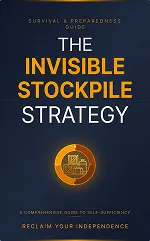
The "Invisible Stockpile" Strategy
How to store 2-4 weeks of supplies that look completely normal to visitors.
Click The Button And Get Instant Access - Start Reading the blueprint directly on your computer, phone, or tablet and start implementing right away.
P.S. — The families who thrived during Hurricane Helene weren't luckier. They weren't richer. They weren't "preppers." They just had a system. For $17.95, you can have the same system—this weekend.
P.P.S. — Remember: Preparing today takes an afternoon. Preparing during a crisis takes a miracle. Which sounds easier?
"By failing to prepare, you are preparing to fail."
Benjamin Franklin
DISCLAIMER: This is not an endorsement from Benjamin Franklin

Frequently Asked Questions
What exactly is The Grid-Down Blueprint?
It’s a digital step-by-step guide (videos + PDFs + checklists) that teaches the simple systems real families used to handle 2–19 day outages without expensive generators or big stockpiles.
Is this "doomsday prepping"?
No. This is practical, real-world blackout preparation — the kind that helped families during Hurricane Helene, the Texas freeze, and California outages. No bunkers, no lifestyle change.
Do I need to spend a lot on gear?
No. The entire Blueprint is designed to work for under $200 total, using inexpensive items or things you already own. It’s about systems, not stockpiling. We even have a budget shopping list to give everyone, regardless of budget a chance to sleep well knowing they are prepared for any disaster.
I live in an apartment. Will this still work?
Yes. Every module works in small spaces, and you get a dedicated Apartment Adaptation Guide that shows you exactly how to set everything up indoors.
I’m not handy or technical. Can I actually do this?
Yes. Everything is broken into simple, follow-along checklists. If you can follow a recipe, you can follow these systems.
How long does it take to get the basics in place?
You can implement the 72-Hour Quick Start Checklist in under an evening. That alone puts you ahead of most families.
I’ve prepped a little already. Will this still help?
Yes. It strengthens your foundation and shows you how to quiet your preparations, stretch supplies, and fix weak points before the next outage.
How do I access the material, and how long do I keep it?
You get instant digital access to all modules and bonuses, and lifetime access to everything (including future updates).
What if it’s not what I expected?
You’re covered by a 30-day “Next Major Outage” guarantee. If you don’t feel significantly more prepared during your next blackout, you get a full refund — no questions asked. Send a simple email to our support, and we'll refund you in full.
Click The Button And Get Instant Access - Start Reading the blueprint directly on your computer, phone, or tablet and start implementing right away.
This site is not a part of the Facebook website or Facebook Inc. Additionally, This site is NOT endorsed by Facebook in any way. FACEBOOK is a trademark of FACEBOOK, Inc.
We can not and do not make any guarantees about your ability to get results or earn any money with our ideas, information, tools, or strategies. What we can guarantee is your satisfaction with our training. We give you a 30-day 100% satisfaction guarantee on the products we sell, so if you are not happy for any reason with the quality of our training, just ask for your money back. You should know that all products and services by our company are for educational and informational purposes only. Nothing on this page, any of our websites, or any of our content or curriculum is a promise or guarantee of results or future earnings, and we do not offer any legal, medical, tax or other professional advice. Any financial numbers referenced here, or on any of our sites, are illustrative of concepts only and should not be considered average earnings, exact earnings, or promises for actual or future performance. Use caution and always consult your accountant, lawyer or professional advisor before acting on this or any information related to a lifestyle change or your business or finances. You alone are responsible and accountable for your decisions, actions and results in life, and by your registration here you agree not to attempt to hold us liable for your decisions, actions or results, at any time, under any circumstance.